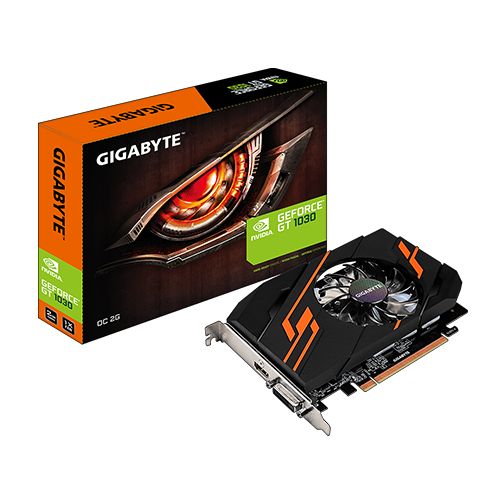
The reason for overclocking the graphics card in this system was purely out of curiosity to see what could be achieved. Almost any GPU less than five years old would be more powerful than the built-in Nvidia GeForce GT 1030 OC with 2 GB and also better connected (only PCIe 3.0 x4!).
The card also does not allow any increase in the power limit, so any overclocking must be satisfied with the original 30 watts. At least this GT 1030 is a version with 2 GB of fast GDDR5; there were also significantly slower variants with DDR4 as VRAM.
As always, overclocking was done with MSI Afterburner, monitored with HWiNFO, and tested for stability with Unigine Heaven.
In the end, these clock speeds were stable:
| GeForce GT 1030 OC | Original | Overclocked |
|---|---|---|
| Core clock | ~1610 MHz (Boost fluctuates naturally) | ~1800 MHz (Boost fluctuates naturally) |
| Core clock difference | – | + 11,8 % |
| VRAM clock | 3004 MHz | 3753 MHz |
| VRAM clock difference | – | + 24,9 % |
| Power draw | 30 Watts | 30 Watts |
| PassMark Points | 2429 | 2855 |
| PassMark difference | – | + 17,5 % |
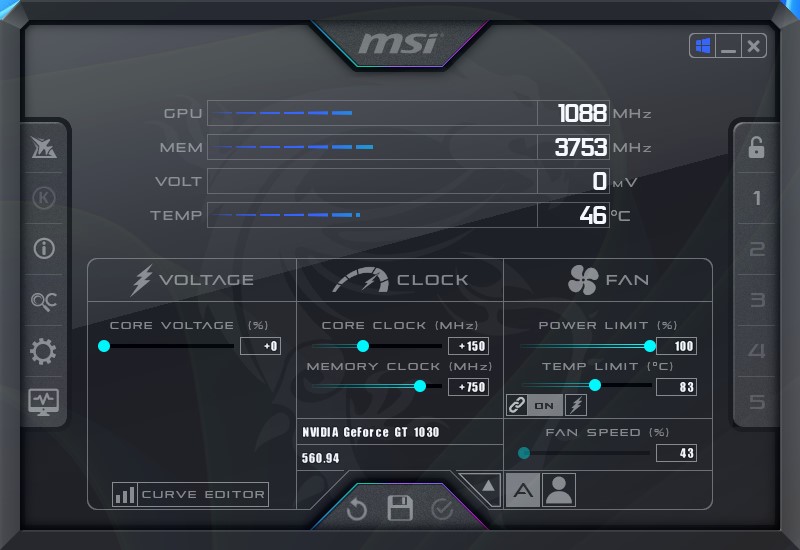
There’s not much to say, got a little more out of it – good.
We’ll continue in the next post with the conclusion and thoughts.