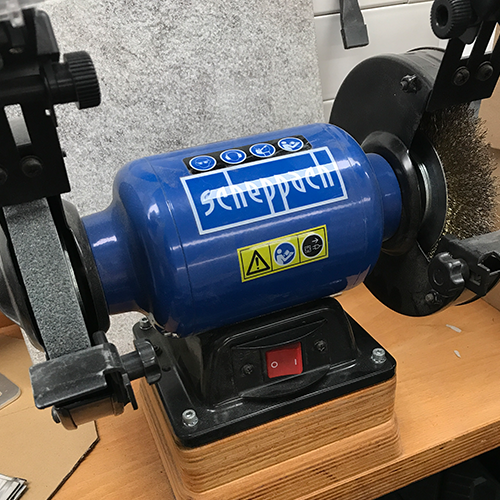
For our workshop, I wanted a bench grinder* that, unlike most, was equipped with a wire brush on one side instead of another, coarser grinding wheel. This poses a problem: a significant imbalance, as the grinding wheel is much heavier and more round than the wire brush.
Regardless of this, a bench grinder is generally a vibrating machine. In my “old” makeshift workshop, there was an older bench grinder with two fairly well-aligned, smooth-running grinding wheels – also screwed to the worktop. Even when starting up, the entire worktop vibrated, let alone when you held something against the wheels with force to grind it.
In our “new” workshop, which is built into the house, I wanted to avoid the problem from the outset, or at least minimize it significantly.
How do you do that?
I had already had experience with so-called “rubber-metal buffers” in the past to decouple a two-cylinder air compressor. It worked so well that it was hard to believe:
The mount on which the compressor stood at full operation basically no longer vibrated, which made everything much quieter. So my first thought for this grinding block was similar – rubber-metal buffers.
Implementation
It’s actually quite simple: First of all, I should mention that I am relatively tall, so a “foot” that raises the bench grinder is very useful for me. This is how I did it:
- Two pieces of 40 mm multiplex cut to size and sanded
- Holes drilled and countersunk in the lower of the two panels so that they can be screwed to the worktop later
- Recesses drilled from the other side so that self-locking nuts can be pressed in to hold the upper panel in place
- Using a 25 mm Forstner bit, cylinders approx. 10 mm deep were drilled into the upper panel so that the buffers could be made to disappear almost completely
- Suitable through holes were drilled in both panels for all screws
I used 20 mm buffers with internal threads on both sides (Type C, Ø 20, Height 20 mm, IG/IG M6, NK 55 (20-20-C)*), with galvanized 8.8 M6 hexagon socket screws* and lock washers both from below (invisible) and from above to secure the grinding block.
Experiences
The decoupling is not 100% effective – slight vibrations can still be felt. This is particularly noticeable because we keep our storage systems for screws etc. on the same worktop – you can feel and hear even the slightest vibration.
Nevertheless, the result is really good: 99% less vibration.
Photos
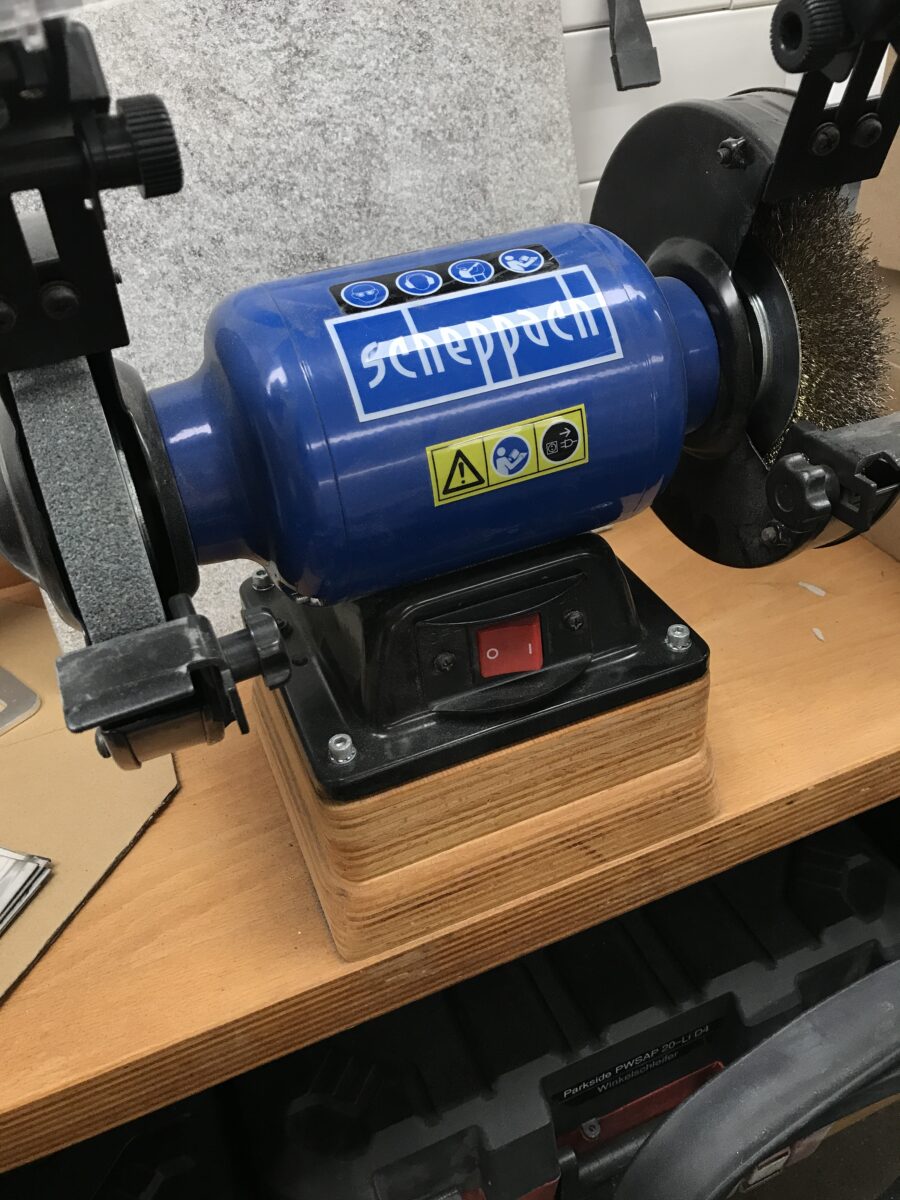


You can clearly see the gap between the plate and the machine; light shines through the gap.