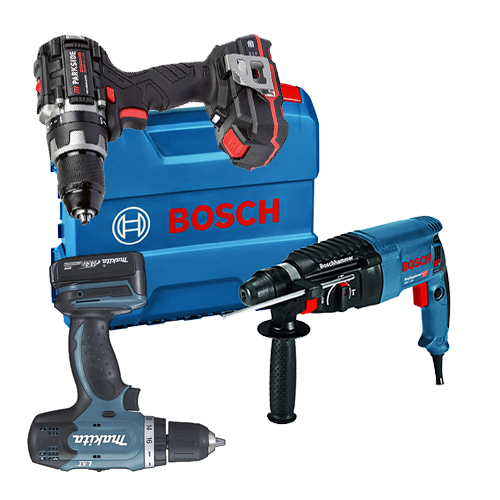
After careful consideration, we decided some time ago to use a battery-powered system instead of corded power tools for our home renovation. In terms of quality, I would only have considered brands such as Bosch Professional, Makita, DeWalt, Milwaukee, etc. – if it weren’t for the really high price, especially for the batteries and chargers.
Milwaukee in particular has undergone several system changes, making newer devices in the same segment incompatible with older batteries. The next step was to discontinue production of the older battery system, and after inevitable defects, the devices gradually became unusable. Absolutely unacceptable. DeWalt did something similar, but some time ago.
What are the advantages of a battery system?
The biggest advantages are mobility and flexibility. In addition, the basic idea of having just a few batteries and chargers that are compatible with many devices is appealing. The convenience is a real bonus when working.
What’s wrong with that?
Actually two things – batteries are basically wear parts, and you also become dependent on the compatible system and thus on the manufacturer. So everything depends on the behavior of the manufacturer of the respective system. In addition, very useful functions such as a vacuum cleaner that switches on automatically on hand-held circular saws, etc., cannot be used.
The starting point
The only cordless tool we already had was a 14.4-volt Makita cordless screwdriver (Newer model*), which is well over 10 years old. It was purchased as a set together with two 2 Ah batteries and a charger in a case. Both batteries have been defective for some time and have been replaced by two replicas from the Far East*. The cordless screwdriver itself still works very well, but has always been a bit weak.
After I was able to purchase a Parkside 20-volt performance cordless screwdriver (brushless!) with a 2 Ah battery and 4.5 Ah charger for a really low price of €66.99 including shipping during a special Black Friday promotion at Lidl at the end of 2022, I quickly made my decision – I would go with Parkside for battery-powered tools.
The reasons were and are obvious:
- Really very inexpensive in relation to quality.
- Green standard devices come with a 3-year warranty, while the black performance versions come with a 5-year warranty.
- Almost all devices come in cases.
- Many items can be ordered online at any time or with short delivery times, and at that time shipping was free for orders over €59 (today €79 with an app coupon).
- There are several different chargers and batteries to suit every budget and application
- The first impression of the performance cordless screwdriver, at least, was “surprisingly good”
However, I still use (additional) 230-volt versions of tools that require continuous power, such as a Bosch Professional SDS-Plus hammer drill*, a Makita 125 mm angle grinder* and a hot air gun.
What is the conclusion after almost 3 years of using Parkside cordless tools?
First of all, it should be noted that we are private individuals; in the commercial sector, I would also recommend equipment developed for commercial use. In that case, the price is also reasonable and the quality is far superior. Our approach was: “If the equipment survives our home renovation, it was a good deal; if not, there is at least a 3 or 5-year warranty, and that should be sufficient.” Renovating is expensive, and if the tools do the job for less than half the cost, then the goal has been achieved.
I regularly checked the Lidl website for offers from the end of 2022 onwards. At that time, there was no explicit advertising for Parkside as there is now, two to three years later. This is also reflected in the price of many items. At first, I wanted to limit myself exclusively to the 20-volt system, but a really good deal on a fine drill grinder, which unfortunately is part of the 12-volt system, persuaded me to go down both paths – even though this is still the only 12-volt device I have.
As expected, our experience has been very mixed—some devices are really good for the price, while others are really poor and unreliable. We also have some 230-volt devices from Parkside, if the offer was good or the intended use is stationary.
We have had bad experiences with the smart batteries, especially with the 8 Ah version. First, the charge status buttons stopped working reliably (even with the 4 Ah smart batteries), then soon stopped working altogether. After about 1.5 years of use, 4 of the 6 batteries could no longer be charged, except with the “jump start trick” . After a few weeks, even that no longer helped; one of the cells inside was defective and could no longer be charged manually. At this point, however, praise for the service department: the complaint was handled professionally and smoothly, and after a week we had four brand-new replacement batteries in use. These are still running well today.
Would I go down this path again?
Yes, but not with every device purchased. Unfortunately, you only realize this after the fact, and as we all know, hindsight is always 20/20. The savings enabled us to purchase significantly more devices than would have been possible with Makita or Bosch Professional, for example. Doubts always remain—something of commercial quality will certainly last a few years longer. On the other hand, Parkside products are not designed for such heavy-duty use, and you can’t expect that of them.
One could argue that you should focus on quality when it comes to the most important tools, which would mean having several parallel systems in terms of battery-powered tools. It has become clear that these devices are indispensable and heavily used:
- Drill driver
- Angle grinder
- Hand-held circular saw
- Jigsaw
- Hammer drill
All in all, Lidl’s long warranty period and service make up for many negative points—but if you want to buy something “for life” or for heavy-duty use, Parkside is not the right choice. Even in expensive systems, batteries are always consumables, which should never be overlooked. Nevertheless, mobility is a real gain in convenience compared to corded devices, especially on a construction site with few working power outlets.
It should be noted that I would only purchase the system as new with a warranty, or as used only if it were practically free. There is a definite risk of irreplaceable failure.
Next, I have created a commented list of the devices we purchased, which makes our experiences much clearer.