Revision 1.1 (01/2026) | Revision 1 (11/2025)
If you just pack salvaged components into boxes and shelves, you don’t get anything out of them. That’s why we have this “guest PC,” which was built almost entirely from leftover parts and serves as a guest computer for LAN games. Considering the circumstances, it still looks pretty good.
The processor cooler is a Frankenstein contraption made from a Scythe Mugen 4, which originally worked for years in an AM3+ system. It was attached to the CPU and motherboard using modified LGA 1151 mounting hardware from BeQuiet. The 120 mm PWM fans are from Arctic and were left over after an AiO water cooling system failed. They are attached to the cooling tower with thick wire (bent to create tension).
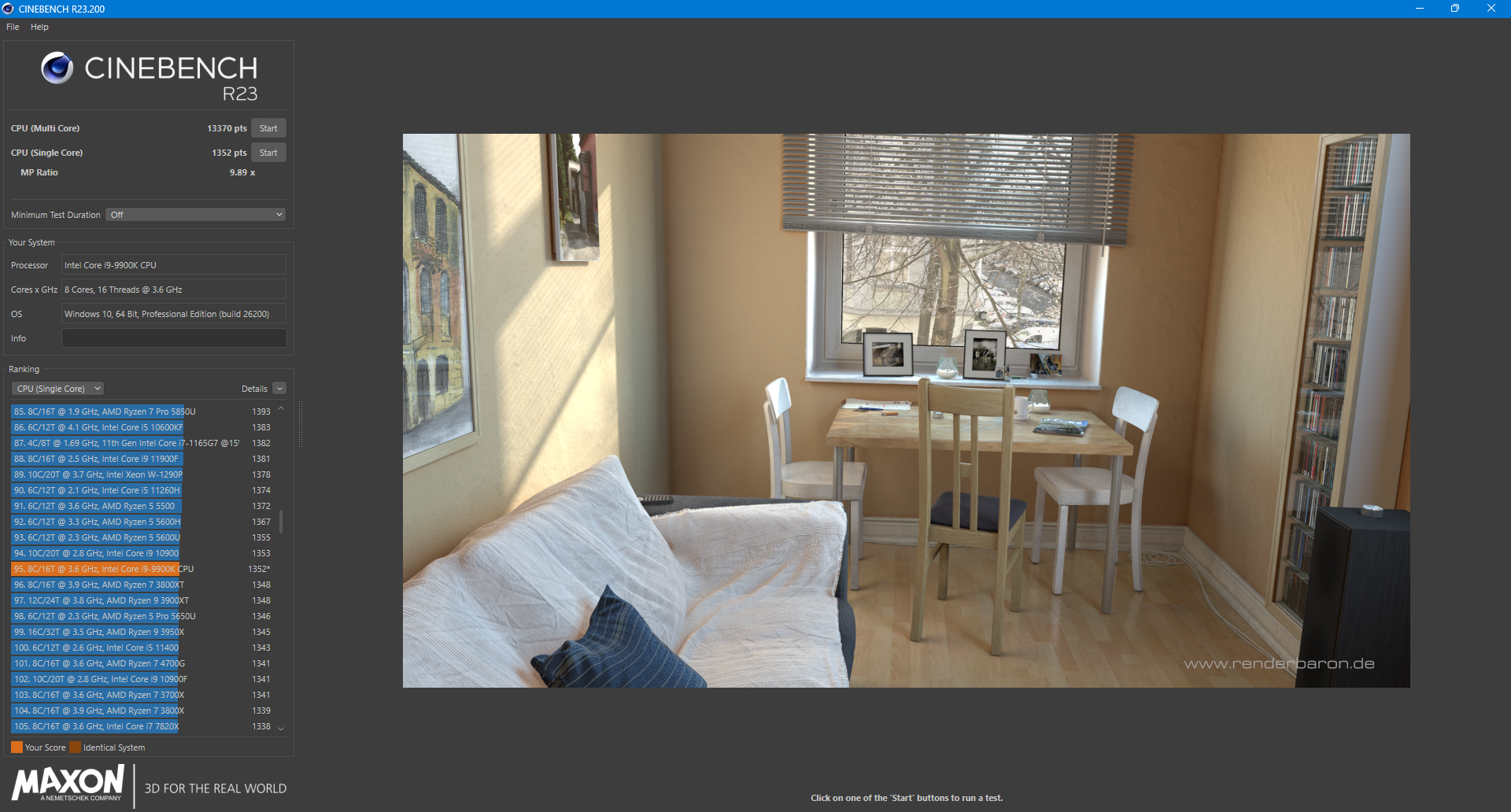
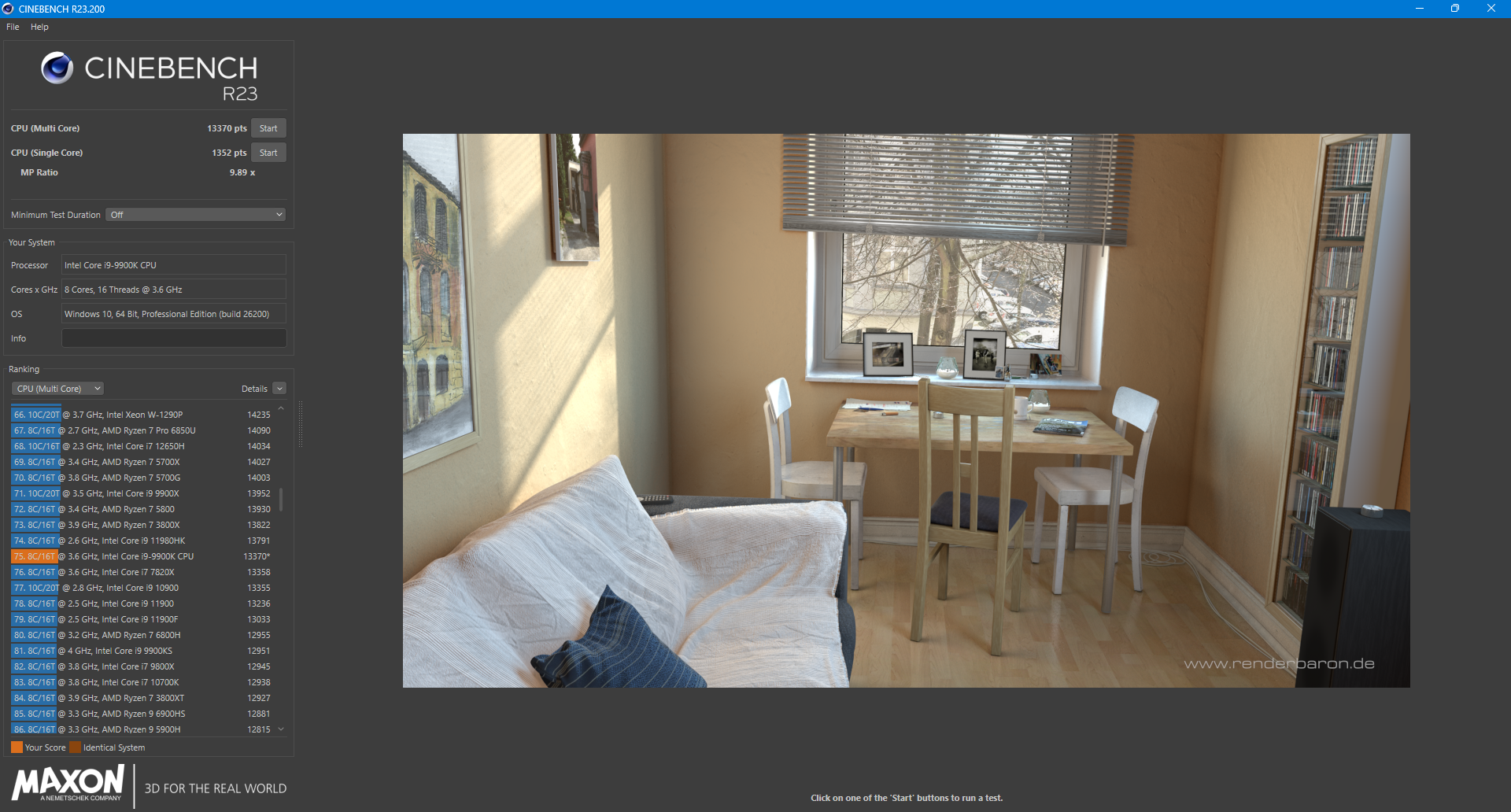
Considering the cooling solution is what it is, it’s actually a miracle that the very hot-headed CPU with “multi-core enhancement,” i.e., an all-core boost corresponding to the single-core boost (5.00 GHz) with all settings on “Auto,” runs stably. This corresponds roughly to an i9-9900KS, with lower-quality silicon at a higher voltage. Of course, the whole thing runs pretty hot (around 90 °C in CB23).
Hardware:
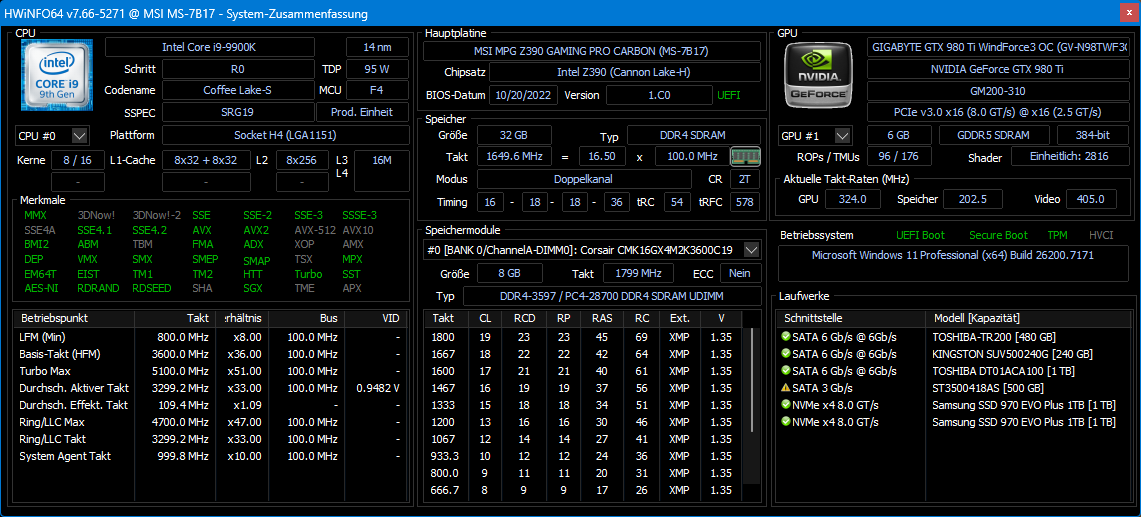
| Processor | Intel Core i9-9900K (SRG19) Coffee Lake → Refresh (14 nm) Stepping R0 8 Cores, 16 Threads Base clock 3.60 GHz Caches: L1 : 512 KB L2: 2 MB L3: 16 MB 95 Watts TDP |
| Socket | H4 Rev. 2 (Desktop) FC-LGA, 1151 Contacts |
| Cooling | Scythe Mugen 4 6 Copper heat pipes and aluminum, tower Two PWM-controlled fans from Arctic |
| Mainboard | MSI MPG Z390 GAMING PRO CARBON ATX |
| Chipset | Intel Z390 (SR406) Cannon Lake H (14 nm) Stepping B0 Passive cooled 6 Watts TDP |
| Memory | 32 GB Corsair Vengeance LPX (4 x 8 GB) DDR4-3600 + DDR4-3200 @ 3300 MHz, 16-18-18-36 2T (1.35 Volts) Dual-Channel DIMM (Unbuffered) 4 of 4 Slots used |
| Graphics | Gigabyte GeForce GTX 980 Ti Windforce 3x OC Maxwell 2.0 → GM200-310-A1 (28 nm, TSMC) 6 GB GDDR5 VRAM PCIe 3.0 x16 Overclocked 250 Watts TDP |
| DirectX OpenGL OpenCL Vulkan CUDA Shader Model | API 12.0, Feature Level 12.1 4.6 3.0 1.4 5.2 6.8 |
| Used Graphics Output | HDMI 2.0 @ 1920 x 1080, 60 Hz |
| Audio | Realtek ALC1220P (PCIe, integrated) |
| Boot device | SSD Samsung 970 Evo Plus (1 TB) 1 GB LPDDR4-1866 DRAM-Cache Passive cooled (MB) NVMe, PCIe 3.0 x4 M.2, 2280 |
| Storage devices | SSD Samsung 970 Evo Plus (1 TB) 1 GB LPDDR4-1866 DRAM-Cache Passive cooled (JEYI) NVMe, PCIe 3.0 x4 M.2, 2280 SSD Toshiba TR200 (480 GB) DRAM-less SATA-III 2.5″ SSD Kingston UV500 (240 GB) 256 MB DDR3L-1600 DRAM-Cache SATA-III 2.5″ HDD Toshiba (1 TB) DT01ACA100 7200 rpm / 32 MB Cache SATA-III 3.5″ HDD Seagate Barracuda (500 GB) ST3500418AS 7200 rpm / 32 MB Cache SATA-II @ SATA-III 3.5″ |
| Network | 1 Gbit Ethernet, RJ-45 Intel I219-V (PCIe, integrated) |
| Power supply | Corsair TX750M 750 Watts max. ATX |
| Case | Corsair iCUE 465X RGB Midi-Tower |
| Miscellaneous | RGB-Lighting |
Firmware:
| Manufacturer | American Megatrends, Inc. |
| Type | UEFI 128 Mb ROM (16 MB) |
| Version | 1.C0, 20.10.2022 |
Software:
| Operating system: | Microsoft Windows 11 Professional German |
| Architecture / Version | x64 / 25H2 |
| Type of Boot | UEFI with Secure Boot |
| Partition table | GUID Partition Table |
Benchmarks:
| PassMark | 9605 Points https://www.passmark.com/baselines/V11/display.php?id=308459947373 |
| Cinebench R23 | Single 1352 Points Multi 13370 Points |
Screenshots: